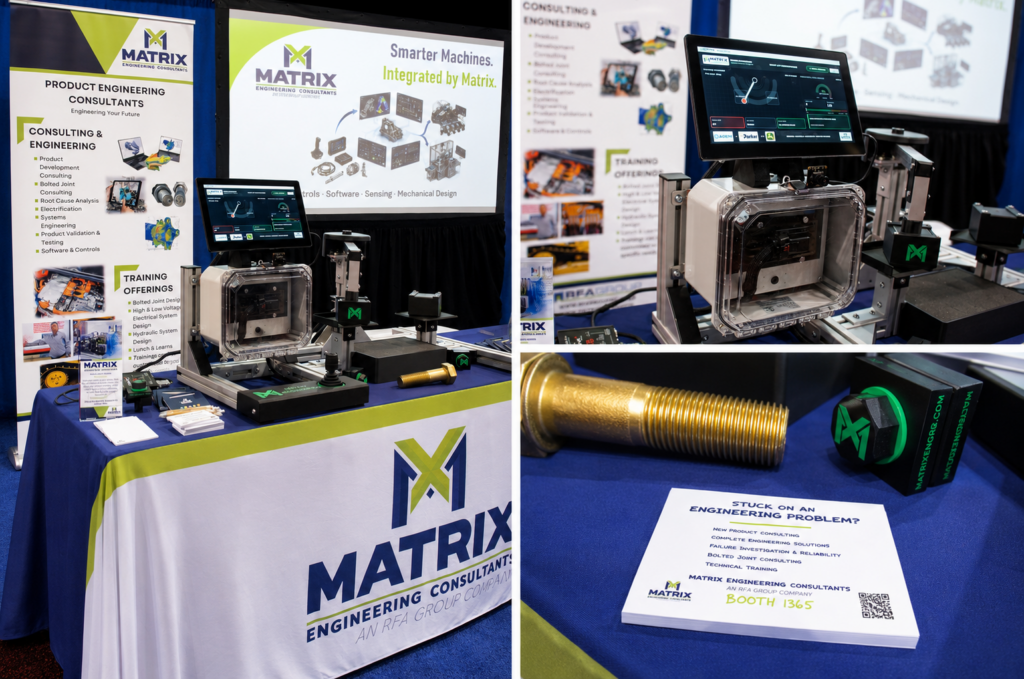
When we began preparing for the 2026 iVT Off-Highway Vehicle Technology Expo, our goal was not simply to exhibit. We wanted to create an experience that would help people understand how Matrix approaches engineering challenges and what it means to work with us as an integrated engineering partner.
That can be difficult to communicate through a list of services. Mechanical design, electrical systems, embedded controls, instrumentation, testing, and engineering analysis may appear to be separate capabilities on paper. In real products, however, they must work together. We wanted our presence at iVT to make that connection clear.
A Demo That Made the Matrix Story Real
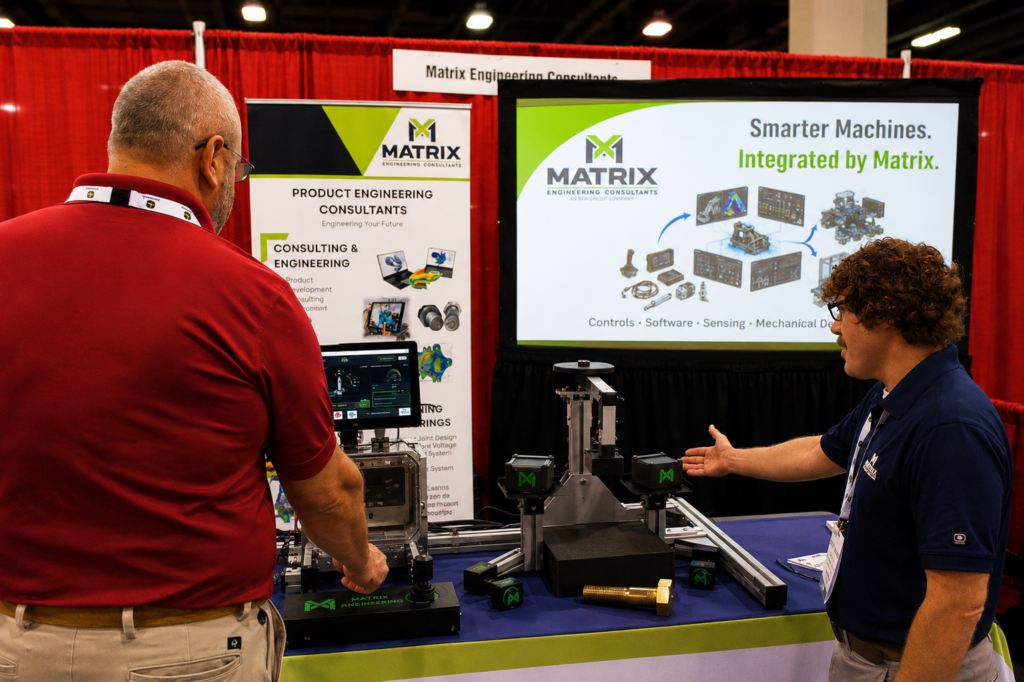
The centerpiece of our booth was a working demonstration developed by the Matrix team. It combined a physical mechanism with operator controls, real-time load sensing, a controller, protective logic, and a customer-style dashboard interface.
As visitors operated the unit, they could see the system respond in real time. Loads were measured and displayed, the interface communicated the condition of the system, and the controls reacted when defined operating limits were reached. The demo was intentionally compact, but the engineering story behind it was representative of a real machine: sense what is happening, interpret the data, communicate useful information to the operator, and use that information to control the system and protect the equipment.
For me, the quality of the demo was also a source of pride. It represented a significant amount of preparation and thoughtful execution by the Matrix team. More importantly, it reflected how we want to approach customer work: collaboratively, practically, and with a clear connection between technical decisions and the way a product will perform in the real world.
Conversations Centered on Real Engineering Needs
The most valuable part of iVT was not simply the number of people who visited the booth. It was the relevance of the conversations.
We spoke with people from across the off-highway and industrial-equipment sectors who were working through real engineering challenges. Several discussions focused on integrating controls, sensing, operator interfaces, and physical machine systems. Others centered on product reliability, failure investigation, and the need to better understand why a component or system was not performing as intended. These conversations aligned closely with where Matrix can provide the greatest value. Some organizations have strong internal teams but lack the bandwidth or specialized expertise to address a difficult technical problem. Others need a multidisciplinary partner capable of looking beyond one component or engineering discipline. In both cases, the need is not simply for additional engineering labor. It is for technical judgment, structured problem-solving, and an accountable team that can help carry a solution into implementation.
Reinforcing Matrix’s Direction
Matrix is building on a long history of deep technical consulting, including failure investigation, reliability engineering, bolted-joint expertise, and product-development support. Our next stage of growth is to connect those strengths more deliberately and help customers with larger, multidisciplinary engineering challenges—from initial insight through implementation.
That does not mean moving away from the specialized expertise that built our reputation. It means using that expertise as a foundation for broader partnerships. A failure investigation may lead to a corrective redesign. A sensing challenge may require controls development and validation. A system-integration need may uncover mechanical, electrical, or reliability considerations. Real engineering problems rarely stay within a single discipline, and Matrix is increasingly structured to address them that way.
Looking Ahead
I left iVT proud of our team and energized by the opportunities ahead. The show created valuable new relationships, but it also gave us something equally important: direct feedback that our capabilities and strategic direction are relevant to the challenges companies are facing.
Our biggest takeaway is that future outreach should continue to prioritize meaningful face-to-face engagement and lead with customer problems. Demonstrations, technical content, and capability materials all have a role, but they are most effective when they create a conversation about a real need.
If your team is facing a system-integration, controls, reliability, or failure-investigation challenge, we would welcome the opportunity to learn more about it.
Scott Hauser
President
MATRIX ENGINEERING CONSULTANTS