Field & Lab Data Acquisition
Capture what your product actually experiences — in the field and in the lab — with multichannel data acquisition that feeds directly into your validation and design process.
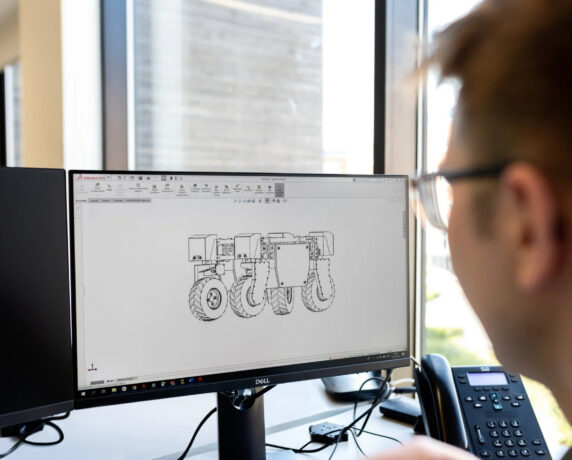
Measured Data for Engineering Decisions
Analysis predicts behavior. Testing confirms it. But both depend on accurate, high-resolution data from the real operating environment. Our field data acquisition services capture the loads, strains, accelerations, temperatures, pressures, and displacements your product actually sees — not the idealized values from a requirements document.
That measured data serves multiple engineering purposes. It defines the load cases that drive your virtual validation, provides the baseline for correlating FEA models against physical behavior, verifies that a design meets its performance targets, and identifies the root cause when something fails in the field. Without it, every analysis carries uncertainty that compounds through the development process.
What We Measure and How
Matrix’s multichannel data acquisition testing capabilities support 100+ simultaneous channels across a wide range of measurement types: strain gauges, accelerometers, thermocouples, pressure transducers, displacement sensors, load cells, CAN bus data, video capture, and GPS tracking. Channels are time-synchronized so that relationships between measurements — a strain spike coinciding with a specific machine event, for example — are captured with precision.
We deploy in both field and lab environments. Field acquisition means instrumenting your product or machine in its actual operating conditions — on a construction site, in a mine, on a test track, across an agricultural duty cycle. Lab acquisition uses controlled loading to isolate specific behaviors or replicate field-measured load histories on a test stand. Many programs use both: field data defines the duty cycle, and the lab reproduces it under repeatable conditions.
Not Sure Where to Start?
Many recognize they need improved data but are uncertain about what to measure. This is common. The first step isn’t selecting sensors; it’s identifying the decision your team has to make.
Matrix helps translate the concern – field failures, uncertain loads, warranty exposure, fatigue risk, launch validation, or lack of confidence in a model – into an instrumentation and analysis plan that collects only the data needed to answer the question.
From Raw Data to Load Cases
The value of data acquisition isn’t the data itself — it’s what you do with it. Our engineers don’t just collect and deliver files. We process, analyze, and interpret the results so they’re directly usable in your engineering workflow.
Load case development testing is one of the most common applications. Field-measured data is processed into representative load cases — rainflow counted for fatigue, peak-valley extracted for strength, statistically characterized for durability — that become the inputs to your FEA models and test specifications. When the analysis is built on measured loads rather than assumed ones, the results carry real credibility.
We also support test-to-FEA correlation, where measured strains and deflections are compared against model predictions to validate or refine the analytical approach. And for field failure investigations, targeted data acquisition on a problem machine or assembly often reveals the loading condition or operating mode that no one anticipated during design.
Frequently Asked Questions
We capture strain, acceleration, temperature, displacement, pressure, load, CAN bus data, video, and GPS — across 100+ simultaneous, time-synchronized channels. If it can be measured with a sensor, we can likely acquire it. The specific instrumentation plan depends on what your validation program needs to learn.
We provide the full data acquisition system — sensors, signal conditioning, recording hardware, and cabling. If your product already has instrumentation installed, we can incorporate existing sensors into our system. We handle all calibration and setup.
Yes. Field data acquisition is one of our core capabilities. We instrument your product or machine and collect data under real operating conditions — whether that’s a single shift or an extended duty cycle study spanning weeks. Our systems are portable and ruggedized for harsh environments.
Both, depending on what you need. At a minimum, we deliver processed, validated data in formats compatible with your engineering tools. Most clients also engage us for the engineering analysis — load case development, statistical characterization, FEA correlation, or root cause interpretation. We tailor deliverables to your workflow.
Measured field or lab data provides the real-world inputs and benchmarks that FEA models need. Measured loads become the boundary conditions for analysis. Measured strains and deflections become the targets the model needs to match. When test and analysis agree, you have confidence in the model. When they don’t, the discrepancy points you directly to what needs refinement.
They feed each other. Analysis identifies what should happen and where to focus testing. Testing confirms whether the model is correct. Field data acquisition provides the measured loads and responses that both analysis and testing need. Most robust validation programs use all three, and we can manage them as an integrated program or deliver any one as a standalone service.
Need data you can trust?
Whether you’re building load cases for a new design, correlating an FEA model, or investigating a field problem, Matrix’s data acquisition team can get you the measurements your engineering decisions depend on.