Virtual Validation
Identify design issues, optimize performance, and reduce physical test cycles — using simulation engineering that answers your questions before you cut metal.
Why Virtual Validation Matters
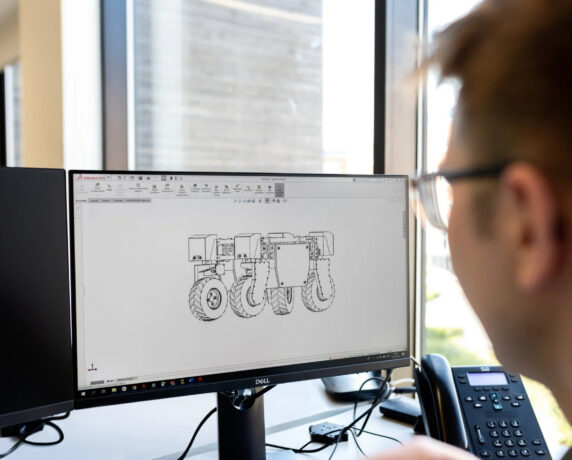
Every design carries assumptions about how loads transfer, where stresses concentrate, how temperatures distribute, and whether a mechanism moves the way it should. Virtual validation is how you test those assumptions computationally — before committing to tooling, prototypes, or production hardware.
The value isn’t just in finding problems. It’s in finding them early, when a design change costs hours in CAD rather than weeks on the shop floor. A well-structured virtual validation program narrows the scope of physical testing, reduces development cycles, and gives your team confidence that the design they’re building will perform as intended. It doesn’t replace physical testing — it makes physical testing more efficient by ensuring you’re testing a design that analysis already says should work.
How We Structure a Virtual Validation Program
Our first step is to translate your business or program risk into an engineering validation plan. From there, we recommend the most efficient combination of simulation, data acquisition, and physical testing needed to answer the question with confidence.
We don’t run simulations just to produce color plots. Every analysis starts with the question the engineering team needs answered, and the modeling approach is scaled to match — simple enough to run efficiently, detailed enough to be credible.
For product development, that often means starting with screening-level models to identify critical load cases and stress concentrations, then building progressively more detailed models for the areas that matter most. For failure investigations, this means building a model that reproduces the observed failure mode and then using it to evaluate root-cause hypotheses and corrective actions. For design optimization, it means running parametric studies across geometry, material, or loading variations to find the configuration that meets all performance targets simultaneously.
We work with your CAD models and material specifications, and if load cases aren’t well defined, we help develop them — often using field-measured data from our data acquisition services. Model results are validated against available test data wherever possible, because a simulation that hasn’t been benchmarked against physical reality is an assumption, not an answer.
What We Deliver
Deliverables are tailored to how your team will use the results. A typical analysis report includes a clear description of the model, loading, and boundary conditions, contour plots and quantitative results at critical locations, margin-of-safety or factor-of-safety assessments against your design criteria, and actionable recommendations — not just what the results are, but what they mean for your design decisions.
For programs that require ongoing simulation support, we can function as an extension of your engineering team — running analyses as the design evolves, participating in design reviews, and updating models as test data becomes available. For one-time studies, we deliver a self-contained report that your team can act on independently.
Frequently Asked Questions
We perform structural FEA (static, dynamic, fatigue, and nonlinear), thermal analysis, CFD, bolted joint analysis, kinematic and mechanism simulation, gear analysis, hydraulic system modeling, and tolerance studies. The specific methods depend on what your design needs to withstand and what questions your validation program needs to answer.
We can import all major CAD formats — STEP, IGES, Parasolid, SolidWorks, CATIA, Creo, NX, and others. If your geometry needs cleanup or simplification for meshing, we handle that as part of model preparation.
That depends on the quality of the inputs — geometry, material properties, boundary conditions, and load cases. A well-built model with accurate inputs and appropriate mesh refinement typically agrees with physical test data within single-digit percentages at critical locations. We validate against test data whenever it’s available, and when it’s not, we clearly communicate the assumptions and their expected influence on results.
Yes. Undefined or poorly defined load cases are one of the most common gaps we encounter. We can develop load cases from field data acquisition, specification requirements, or first-principles engineering judgment — depending on the information available and the level of rigor the application demands.
No. In fact, starting analysis before the design is finalized is where simulation adds the most value. Preliminary models on early-stage geometry can identify fundamental issues — undersized sections, unfavorable load paths, thermal bottlenecks — while changes are still easy and inexpensive. Waiting until the design is frozen means analysis can only confirm or reject, not guide.
They feed each other. Analysis identifies what should happen and where to focus testing. Testing confirms whether the model is correct. Field data acquisition provides the measured loads and responses that both analysis and testing need. Most robust validation programs use all three, and we can manage them as an integrated program or deliver any one as a standalone service.
Ready to test your design before you build it?
Whether you’re launching a new product, investigating a failure, or looking to reduce physical test cycles, Matrix’s virtual validation services can give your team the simulation-based answers your engineering decisions depend on.